
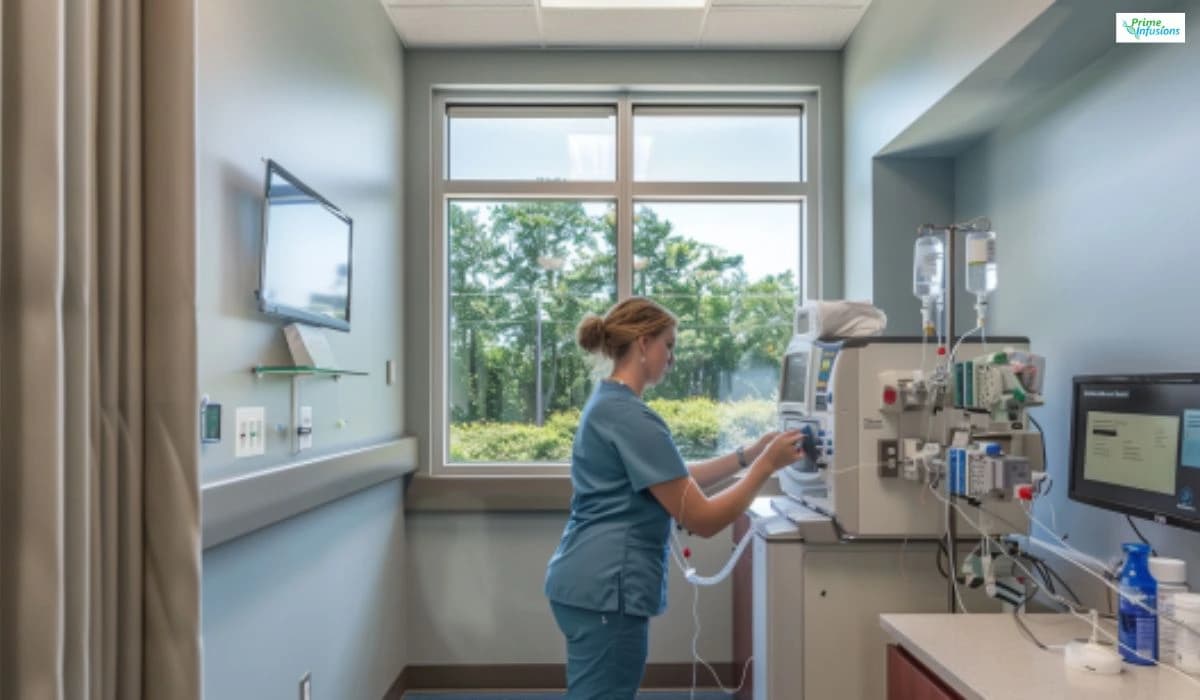
A first infliximab infusion is a longer appointment than most people expect, and the steps that surprise patients happen before the drip starts. Infliximab is administered as Remicade and as the biosimilars Inflectra, Renflexis and Avsola, plus unbranded infliximab, and Prime Infusions administers all five across its New York infusion centers. This article covers what has to be in place before a first dose, how the dose is calculated, how long FDA-approved labeling says the infusion must run, and what that labeling reports about infusion reactions.
What infliximab is, how it works and the complete boxed warning are covered on the Remicade medication page. This article is about the visit.
What has to be in place before a first infliximab infusion?
Tuberculosis screening. Every infliximab product carries the boxed warning headed WARNING: SERIOUS INFECTIONS and MALIGNANCY, and that warning states that "Patients should be tested for latent tuberculosis before REMICADE use and during therapy. Treatment for latent infection should be initiated prior to REMICADE use." Both halves are binding: the test happens before the first dose, and testing continues during treatment. If the test is positive, treatment for the latent infection begins first. The same boxed warning also addresses invasive fungal infections, opportunistic bacterial and viral infections, lymphoma and other malignancies reported in children and adolescents treated with TNF blockers, and hepatosplenic T-cell lymphoma, reported mostly in adolescent and young adult males with Crohn's disease or ulcerative colitis who were also taking azathioprine or 6-mercaptopurine. Read it in full in the FDA-approved Remicade prescribing information.
Tuberculosis screening is a coverage requirement as well as a safety one: the Medicare contractor billing article for infliximab and biosimilars, Article A52423, requires documentation that tuberculosis evaluation and treatment were initiated before therapy. The second item is the prescriber's order, which names the specific product, the dose and the infusion rate. Which product appears there is decided by the prescriber and the health plan, not chosen at the chair; the five are compared in our five-way infliximab product comparison, with product detail on the Inflectra, Renflexis, Avsola and unbranded infliximab pages. Most plans require prior authorization first, covered in our article on infliximab prior authorization and appeals.

How is an infliximab dose calculated?
Infliximab is dosed by body weight in milligrams per kilogram, so a weight is taken and the dose for that visit is calculated from it. According to the Remicade prescribing information, the dose is 5 mg/kg for Crohn's disease, ulcerative colitis, ankylosing spondylitis, psoriatic arthritis and plaque psoriasis, and 3 mg/kg for rheumatoid arthritis, which the label indicates in combination with methotrexate. Rheumatoid arthritis is the only indication that starts at 3 mg/kg. Weight is recorded at each visit rather than once at intake, and Article A52423 lists patient weight among the documentation Medicare expects on an infliximab claim.
How long does a first infliximab infusion take?
The Remicade prescribing information states that the drug "must be administered intravenously for at least 2 hours" through an in-line, low-protein-binding filter. Two hours is a labeled floor for the infusion itself, not a scheduling estimate, and there is no shortened or one-hour infliximab infusion in current United States labeling. The total appointment is longer than the infusion, because it also includes check-in and weight, a pre-infusion assessment, intravenous access, any premedication the prescriber has ordered, reconstitution and dilution of the drug, and monitoring before discharge.
Prime Infusions does not publish a single total-visit figure on this page, because the total varies with the product, the dose and the individual patient. The Prime Infusions scheduling center gives the expected block for a specific appointment at a specific location when the appointment is booked, on 718-443-4000. Plan for a commitment meaningfully longer than two hours.
Why are the first three infliximab infusions so close together?
Every labeled infliximab indication uses the same induction schedule: infusions at week 0, week 2 and week 6. Maintenance then runs every 8 weeks for Crohn's disease, ulcerative colitis, rheumatoid arthritis, psoriatic arthritis and plaque psoriasis, and every 6 weeks for ankylosing spondylitis, the only indication on a 6-week interval. Three appointments therefore fall inside roughly six weeks, and then the schedule opens out. That front-loaded rhythm is worth knowing before booking time off work, arranging childcare or planning travel.
| Indication | Dose | Induction | Maintenance interval |
|---|---|---|---|
| Crohn's disease (adults; pediatric patients 6 years and older) | 5 mg/kg | Weeks 0, 2, 6 | Every 8 weeks |
| Ulcerative colitis (adults; pediatric patients 6 years and older) | 5 mg/kg | Weeks 0, 2, 6 | Every 8 weeks |
| Rheumatoid arthritis (with methotrexate) | 3 mg/kg | Weeks 0, 2, 6 | Every 8 weeks |
| Ankylosing spondylitis (adults) | 5 mg/kg | Weeks 0, 2, 6 | Every 6 weeks |
| Psoriatic arthritis (adults) | 5 mg/kg | Weeks 0, 2, 6 | Every 8 weeks |
| Plaque psoriasis (adults) | 5 mg/kg | Weeks 0, 2, 6 | Every 8 weeks |
Source: Remicade prescribing information, Dosage and Administration.
How likely is an infliximab infusion reaction?
The Remicade prescribing information reports that "approximately 20% of REMICADE-treated patients experienced an infusion reaction compared with 10% of placebo-treated patients," counting reactions during an infusion or within 1 hour after one. Across all infusions studied, 3% were accompanied by nonspecific symptoms such as fever or chills, 1% by cardiopulmonary reactions, primarily chest pain, hypotension, hypertension or dyspnea, and fewer than 1% by pruritus or urticaria. Serious infusion reactions occurred in fewer than 1% of patients and included anaphylaxis, convulsions, erythematous rash and hypotension.
Roughly one patient in five has some reaction, most of them mild; serious reactions are uncommon but real, which is why an infliximab infusion is supervised throughout. The labeling directs that appropriate personnel and medication be available to treat reactions occurring during and shortly after the infusion, that mild to moderate reactions be managed by slowing or stopping the infusion, and that a serious reaction means the infusion is discontinued. Tell the nurse about any new sensation, including itching, flushing, chest tightness, breathlessness or feeling cold, at the moment it starts rather than at the end.
Will premedication be given before an infliximab infusion?
Only if the prescriber orders it. The Remicade labeling is permissive here: "Prior to infusion with REMICADE, patients may be premedicated with histamine-1 receptor antagonists, histamine-2 receptor antagonists, acetaminophen, and/or corticosteroids." The operative word is may. Premedication is a prescriber decision written into the order, not a labeled requirement and not something Prime Infusions applies routinely to every patient. When it is ordered it is given before the infusion begins, which adds time. Ask the prescriber whether anything is on the order, because antihistamines in particular can cause drowsiness.
What side effects were most common in the infliximab trials?
These figures come from the Remicade label's adult rheumatoid arthritis trial table, covering adverse reactions in at least 5% of patients who received four or more infusions: 1,129 patients treated with Remicade against 350 on placebo. Upper respiratory tract infection was reported in 32% of Remicade-treated patients versus 25% on placebo; headache 18% versus 14%; sinusitis 14% versus 8%; abdominal pain, pharyngitis and coughing each 12% versus 8%; and rash 10% versus 5%.
Two qualifications belong with those numbers. The label cautions that clinical trial rates are observed under widely varying conditions and cannot be directly compared with rates in other trials or in practice. And these are adult rheumatoid arthritis figures: adverse reaction rates for pediatric Crohn's disease and pediatric ulcerative colitis are reported separately in the labeling and should not be assumed to match them.
What should you bring, and can you drive yourself home?
Bring what follows from how an infliximab appointment actually works:
- Photo identification and the current insurance card.
- The name of the exact product on the order: Remicade, Inflectra, Renflexis, Avsola or unbranded infliximab.
- A complete medication list naming methotrexate, azathioprine, 6-mercaptopurine and any corticosteroid, which matter to rheumatoid arthritis dosing and to the boxed warning.
- The date and result of the latent tuberculosis test, if it was done elsewhere.
- The prescriber's office phone number.
- Any scheduled medication due during the visit, and something to occupy at least two hours.
Whether to arrange a ride home after a first infliximab infusion is a question for the prescriber who wrote the order, not one this page can settle. Two facts inform it: the labeling describes infusion reactions occurring during an infusion or within 1 hour afterward, and premedication, if ordered, may include antihistamines that cause drowsiness. Ask the prescriber directly before a first dose.
How do you schedule a first infliximab infusion at Prime Infusions?
Patients can start with the Remicade and infliximab request form or call Prime Infusions on 718-443-4000; referring physicians send orders through the Prime Infusions referral page. Infliximab is administered at Prime Infusions locations across New York, including the Manhattan infusion center on the Upper East Side, the Brooklyn infusion center on Foster Avenue and the Queens infusion center in Fresh Meadows. Coverage is determined by the health plan; the Prime Infusions team verifies benefits and submits the authorization request, and the plan makes the determination. Clinical background stays on the Prime Infusions Remicade page.
This article is for general education and is not medical advice, a diagnosis, or a treatment recommendation. Every infliximab product carries an FDA boxed warning headed "WARNING: SERIOUS INFECTIONS and MALIGNANCY", covering serious infections including tuberculosis and invasive fungal infection, and malignancy including lymphoma and hepatosplenic T-cell lymphoma; review the full prescribing information for the product prescribed to you and discuss your individual risk factors with your treating clinician. Coverage and out-of-pocket cost are determined by your health plan.