
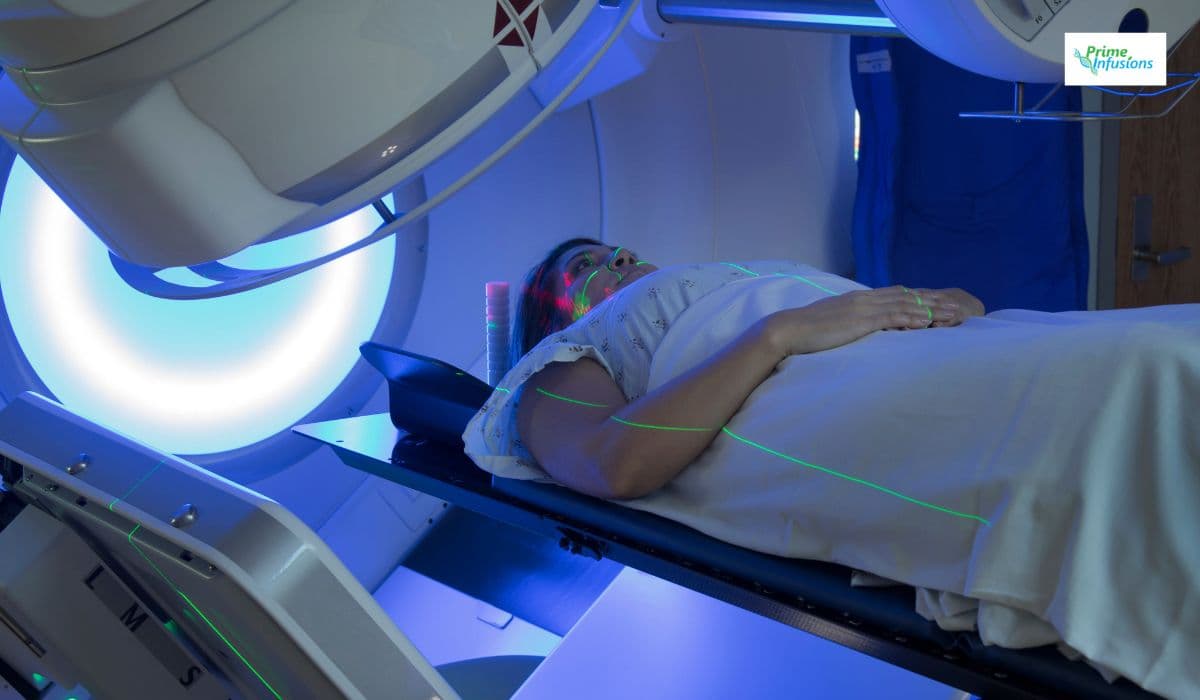
An infliximab infusion does not have one price. The same product, at the same weight-based dose, over the same labeled infusion time, can produce a different allowed amount depending on where the infusion is given and what the patient's health plan says about that site. Prime Infusions publishes no dollar figure for an infliximab infusion, because one number ignoring plan, site and dose would be wrong for almost every reader.
What can be described precisely is the mechanism, and how to obtain a real figure in writing. Coverage, site-of-care approval and out-of-pocket cost are determined by your health plan; Prime Infusions verifies benefits and submits the authorization request. Clinical detail sits on the Prime Infusions Remicade page and the pages for Inflectra, Renflexis, Avsola and unbranded infliximab.
Why does the same infliximab infusion cost more at a hospital than at a freestanding infusion center?
A hospital outpatient department and a freestanding ambulatory infusion suite are different provider types that bill under different payment systems and separately negotiated contract rates. The same infliximab product, the same milligram-per-kilogram dose and the same nursing time therefore generate different allowed amounts depending on which entity submits the claim, before any patient cost sharing is applied. Nothing about the drug changes with the address: the FDA-approved REMICADE prescribing information instructs that the infusion must be administered intravenously for at least 2 hours through an in-line, low-protein-binding filter, in either setting.
This is a structural feature of how medical claims are priced in the United States, not a comment on quality of care. Hospital outpatient infusion exists because some patients need a hospital around them, and for those patients it is the correct site. For everyone else, the setting is a variable worth settling before the first infusion.
| Compared | Hospital outpatient department | Freestanding infusion suite |
|---|---|---|
| Billing entity | Bills as a hospital facility | Bills as a non-hospital place of service |
| Rate structure | Hospital outpatient payment rules and contract rates | Non-hospital rules and negotiated rates |
| Labeled infusion time | At least 2 hours per the REMICADE label | At least 2 hours per the REMICADE label |
| Dose in mg/kg | Prescriber-set, unchanged by site | Prescriber-set, unchanged by site |
| Plan approval | Enumerated criteria under UnitedHealthcare policy 2026D0121V | A well accepted place of service under the same policy |
What does UnitedHealthcare's site-of-care policy say about where infliximab is infused?
For many commercial plans the site of care is a coverage decision, not only a price difference. UnitedHealthcare's commercial policy Provider Administered Drugs - Site of Care, Policy 2026D0121V, effective August 1, 2026, carries Remicade (infliximab), Inflectra (infliximab-dyyb), Renflexis (infliximab-abda) and Avsola (infliximab-axxq) on its drug list. The policy's rationale states that "Alternative Sites of Care, such as non-hospital outpatient infusion, physician office, ambulatory infusion suites, or home infusion services are well accepted places of service for medication infusion therapy. If an individual does not meet criteria for outpatient hospital facility infusion, alternative sites of care may be used."
Hospital outpatient administration must therefore be justified against the policy's criteria. Cigna takes the same general position in Medication Administration Site of Care, Policy 1605, effective 6/15/2026, which states that where hospital criteria are not met "an alternative less intensive site of care should be utilized." Payer policies are revised; check the version current for your plan.
When does a health plan approve hospital outpatient infliximab infusion?
Hospital outpatient infusion remains the approved setting for patients who need it, and payer site-of-care policy is written to preserve that. Under UnitedHealthcare policy 2026D0121V, hospital outpatient administration is approved on enumerated criteria, which include medical instability requiring specialized monitoring; physical or cognitive impairment that makes another site unsafe; severe vascular access issues; previous severe adverse events during infusion not managed with standard interventions; an initial or re-initiated infusion after a gap in therapy; and the absence of any suitable alternative site. Continued hospital outpatient administration is reassessed, not approved indefinitely.
Where the criteria are not met, Prime Infusions operates 13 ambulatory infusion centers across New York, including the Manhattan infusion center on the Upper East Side, the Brooklyn infusion center on Foster Avenue and the Port Jefferson infusion center in Suffolk County. Which sites a plan approves is determined by that plan.
Does the infliximab product I receive change what gets billed?
The product is a separate variable from the site, and it is largely set by the plan. UnitedHealthcare's Commercial Medical Benefit Drug Policy for infliximab, Policy 2026D0004AR, effective February 1, 2026, designates Inflectra and Avsola as preferred and Remicade and Renflexis as non-preferred, requiring documentation of a trial of at least 14 weeks of Inflectra or Avsola, or documented intolerance or contraindication, before a non-preferred infliximab is covered. Cigna Policy PSM005, effective 08/15/2026, names the same two preferred products. Preferred and non-preferred are the payers' own coverage-tiering terms, not a clinical ranking.
Under Medicare Part B the product also changes the payment formula. CMS states that Medicare pays ASP plus 6 percent for most separately payable Part B drugs and biologicals, while for a biosimilar the payment limit is the biosimilar's ASP plus 6 percent of the reference biological's ASP, or plus 8 percent for qualifying biosimilars under section 1847A(b)(8)(B) of the Act. Product selection is a prescriber decision interacting with payer policy; our article on a payer-directed switch to a biosimilar covers what that changes.
How is an infliximab infusion actually billed?
Reading an infliximab statement is easier once the units are understood. The Medicare contractor billing article A52423, Billing and Coding: Infliximab and biosimilars, which covers New York jurisdictions, specifies that infliximab comes in 100-mg vials and that the dosage associated with the HCPCS code is 10 mg, with units rounded up to a whole unit. Product-specific codes apply: J1745 for infliximab, Q5103 and Q5104 for biosimilars effective 04/01/2018, and Q5121 for infliximab-axxq effective 07/01/2020.
Because infliximab is dosed in milligrams per kilogram, body weight drives the number of 10-mg units billed, which is why weight is measured at each visit and why Article A52423 expects patient weight in the record. Two patients on the same schedule at the same site can see different drug lines because they weigh different amounts.
What actually determines my own out-of-pocket cost for an infliximab infusion?
Once product, dose and site of care are fixed, benefit design decides what the patient pays:
- Plan type: commercial coverage, Medicare Part B, Medicare Advantage, Medicaid, or a primary plan with secondary coverage.
- Where the patient stands against the annual deductible when the infliximab course begins.
- Whether cost sharing is percentage coinsurance, which tracks the dose, or a flat copay, which does not.
- Whether the infusion site and the administering clinicians are in network.
- Whether the infliximab drug is billed by the infusion center from its own inventory or shipped in by a specialty pharmacy, which decides whether the drug runs through the medical or the pharmacy benefit.
- The annual out-of-pocket maximum, often the figure that matters most across a plan year.
Why will nobody quote me a price for an infliximab infusion?
Part of the answer is that the number does not exist until the plan, product, dose and site are known. In New York there is also a legal reason. New York Education Law section 6530(27) defines professional misconduct to include advertising that "makes any claim relating to professional services or products or the costs or price therefor which cannot be substantiated by the licensee." A price, price range or percentage saving for an infliximab infusion is a cost claim no provider can substantiate for an individual reader, so Prime Infusions publishes none, here or in our article on IVIG cost and site of care in New York.
How do I get my own infliximab number in writing?
A real figure requires five pieces of information, in this order.
- Get the product, the dose in mg/kg and the infusion frequency from the prescriber. Maintenance intervals differ by indication - every 8 weeks for Crohn's disease, ulcerative colitis, rheumatoid arthritis and psoriatic arthritis, every 6 weeks for ankylosing spondylitis - so infusions per plan year differ by patient.
- Ask the health plan for the benefit determination in writing, naming the product, the HCPCS code, the diagnosis code and the units requested. A verbal call-center quote is not a determination.
- Confirm that the intended site of care is approved for infliximab under that plan.
- Ask whether the infliximab drug will be billed by the infusion center or shipped by a specialty pharmacy.
- Ask for the remaining deductible, the annual out-of-pocket maximum and the date the plan year resets.
How do I get benefits verified for infliximab at Prime Infusions?
Prime Infusions verifies benefits and pursues prior authorization for Remicade, Inflectra, Renflexis, Avsola and unbranded infliximab, then reports back what the plan has determined. Coverage, authorization, site-of-care approval and out-of-pocket cost are determined solely by your health plan. To begin, submit the Remicade and infliximab request form or call Prime Infusions at 718-443-4000. Referring physicians can send a patient through the referrals page; if a plan has denied a request, our article on infliximab prior authorization denials and appeals sets out what happens next. Product detail is on the Prime Infusions Remicade page.
This article is for general education and is not medical advice, a diagnosis, or a treatment recommendation. Every infliximab product carries an FDA boxed warning headed "WARNING: SERIOUS INFECTIONS and MALIGNANCY", covering serious infections including tuberculosis and invasive fungal infection, and malignancy including lymphoma and hepatosplenic T-cell lymphoma; review the full prescribing information for the product prescribed to you and discuss your individual risk factors with your treating clinician. Coverage and out-of-pocket cost are determined by your health plan.